
Guest Post Guidelines: The 9 Sections Publishers Need
Guest post guidelines are the cheapest protection a publisher has. They filter out most of what you would have rejected anyway, they set expectations before anyone writes a word, and — since Google revised its site reputation policy in August 2026 — they document the editorial oversight that policy now explicitly weighs.
Most publisher guidelines pages are three sentences about word count and a link to an email address. This guide sets out what guest post guidelines should actually contain, why each section exists, and a structure you can adapt.
Why guest post guidelines matter more than they used to
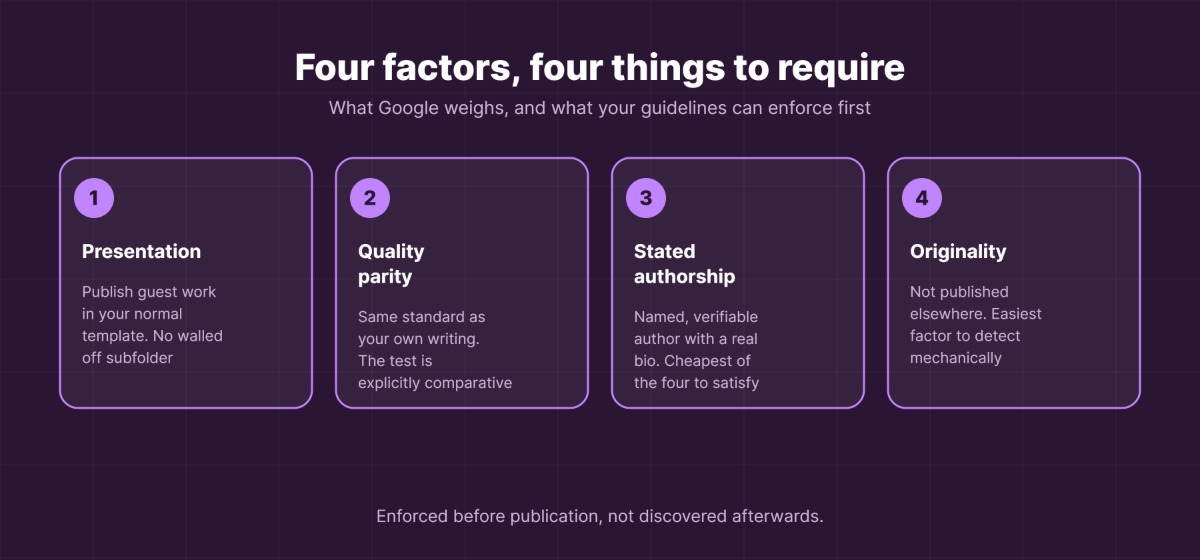
Google’s site reputation policy covers third-party content hosted on a domain mainly because of ranking signals that domain earned with its own work. The policy now names four factors: how the content is presented, its quality relative to the main domain, its stated or implied authorship, and whether it appears elsewhere in identical form.
Read that list as a specification. Every one of those four is something guest post guidelines can control at the point of submission rather than discover after publication. A publisher with enforced guidelines is a publisher whose hosted content looks like part of the publication — which is precisely the distinction the policy draws. The full breakdown is in our piece on what the site reputation policy changed.
There is a commercial argument too, and it is the stronger one. Clear guest post guidelines reduce the time you spend on submissions you will reject, raise the average quality of what you publish, and let you charge more because buyers can see what they are getting.
What guest post guidelines should contain
Nine sections make up a complete set of guest post guidelines. Most publishers have two of them.
1. What you publish, and what you do not
Name the topics you cover, in the words you would use to describe your own publication. Then name the ones you refuse — the categories you will not touch at any price.
This single section removes most bad submissions. A site that states plainly it does not accept gambling, adult, pharmaceutical or cryptocurrency content stops receiving those pitches, and stops being listed on the vendor lists that trade in them.
2. Authorship requirements
State that every article is published under a named author with a real, verifiable identity, and say what you need: full name, a two-line biography, a professional profile or website, and a photograph if you use them.
Stated authorship is one of the four factors Google names. It is also the cheapest of them to satisfy and the one most guest content fails, because bulk placement operations do not want a named person attached to anything.
Decide your position on pen names and agency-submitted content and write it down. “We publish under the name of the person who wrote it” is a defensible line.
3. Originality and exclusivity
Require that the article is original, has not appeared elsewhere, and will not be republished. Say you check, and then check — a distinctive sentence pasted into a search engine in quotes takes ten seconds.
Duplication across sites is the fourth factor, and it is the most mechanically detectable of them. Accepting syndicated placement content puts your domain into a cluster you did not choose to join, alongside every other site that took the same article.
4. Quality standards, stated concretely
Vague quality language does nothing. Concrete requirements do.
Set a minimum length that reflects what you actually publish. Require sources for factual and statistical claims, and specify that sources should be primary rather than another blog. State that you expect the article to be as good as your own content — the quality factor Google describes is explicitly comparative, so a publication with strong original work and weak paid work is more exposed than one that is consistent throughout.
Say whether AI-assisted drafting is acceptable and on what terms. Whatever your position, having one and stating it is better than discovering it case by case.
5. Links: how many, what kind, and where
The section everyone actually reads, so be exact.
State the maximum number of links to the author’s own properties — one or two is typical. Require that links are contextually relevant to the paragraph they sit in. State your position on link attributes clearly, because for paid placements Google’s link spam policy expects rel="sponsored" or rel="nofollow", and whatever you decide, decide it deliberately rather than by default.
Refuse links to specific categories regardless of the article’s topic — the gambling link inside an article about interior design is the oldest trick in guest posting.
Say what happens to links over time. If they are permanent, say so; buyers pay more for a written commitment. If you review content after a period, say that instead. What you must not do is quietly switch links to nofollow after ninety days, which is a known practice and a reputational problem when discovered.
6. Anchor text rules
Set a policy and hold it: no exact-match commercial anchors, or a strict limit of one. Require that anchors read naturally in the sentence.
This protects both sides. Over-optimised anchors are a risk to the buyer’s profile and make your outbound link pattern conspicuous, and a publisher enforcing a sane anchor policy is one of the things experienced buyers look for.
7. Disclosure
Decide how paid placements are labelled and state it. A contributor byline, a sponsored label, or a disclosure line — the choice is yours, but it should be consistent and it should be visible.
Publishers worry this devalues the placement. In practice, the sites that survive are the ones that handled disclosure openly, and buyers who want you to hide it are buyers whose expectations you cannot meet anyway.
8. Formatting and presentation
Specify the structure you want: headings, paragraph length, image requirements and rights, how to supply sources.
There is a policy reason as well as a practical one. Presentation is the first of the four factors — content that looks different from the rest of the site reads as separate from it. Guest articles should appear in your normal template, with your normal typography, in your normal sections. Never in a walled-off subfolder with its own design.
9. Process, price and rejection
State how to submit, how long you take to respond, whether you edit before publishing, and what happens if you reject something — particularly whether payment is refunded.
On price, publishing a rate card or a range filters out buyers you would waste time on. Our guide on what to charge for a guest post covers how to set the number.
Reserve the right to decline anything without explanation, and the right to remove content later if it turns out to be inaccurate or duplicated. Both are worth having in writing.
Guest post guidelines only work if you enforce them
Guidelines nobody applies are worse than none, because they document a standard you are visibly not meeting.
The minimum viable enforcement is three checks per submission, and it takes about five minutes. Is the author a real, findable person? Does a distinctive sentence from the article appear anywhere else? Are the links relevant to the paragraph, within the limit, and pointing where they claim?
Reject on any failure. The revenue from one bad placement is small; a domain that has taken two hundred of them is a domain with a short remaining life.
A guest post guidelines structure you can adapt
A workable guest post guidelines page, in order: what we publish; what we never publish; who may write (authorship and verification); originality requirements; quality and sourcing standards; links (number, relevance, attributes, permanence); anchor text policy; disclosure; formatting; how to submit and what it costs; our right to decline or remove.
Keep it on a single indexed page, linked from your main navigation or footer. A public guidelines page is itself a signal — to buyers that you are a real publication, and to anyone assessing the site that hosted content is governed rather than accepted.
Guest post guidelines: the short version
Write down what you publish and what you refuse. Require named, verifiable authors. Require originality and actually check it. Hold guest content to the same standard as your own, because the comparison is explicitly what gets assessed. Be exact about links, anchors and attributes. Disclose consistently. Publish guest articles in your normal template. And enforce all of it, because unenforced guest post guidelines document a standard you are failing rather than meeting.
Publishers listing with us set their own guidelines and their own price, with verified traffic shown to buyers before they commit. See how selling guest posts works →
Frequently asked questions
What should guest post guidelines include?
Topics accepted and refused, authorship and verification requirements, originality rules, concrete quality standards, link limits and attributes, anchor text policy, disclosure, formatting, submission process and price, and your right to decline or remove.
Do guest post guidelines affect SEO?
Indirectly but meaningfully. Google’s site reputation policy weighs presentation, quality parity, stated authorship and duplication — all four are things guidelines can enforce before publication rather than discover afterwards.
Should I require a named author?
Yes. Stated authorship is one of the four factors Google names, it is the cheapest to satisfy, and requiring it removes most bulk placement operations from your inbox immediately.
How many links should I allow in a guest post?
One or two to the author’s own properties is typical, and they should be contextually relevant to the paragraph they appear in. Refuse links to categories you would not cover editorially.
Should guest posts be labelled as sponsored?
Decide a consistent policy and state it publicly. For paid placements, Google’s link spam policy expects links to be qualified with sponsored or nofollow, and publishers who handled disclosure openly are the ones still trading.
Can I publish guest posts in a separate section?
You can, but it works against you. Presentation is the first factor Google names, and content in a distinct template or walled-off subfolder reads as separate from the publication rather than part of it.
What if a buyer refuses my guidelines?
Decline the placement. A buyer who wants undisclosed, unattributed or over-optimised content is buying a short-term result at your domain’s expense, and the fee will not cover it.